- August 23, 2026
- 0 Comments
- By admin
What Are the Best Google Ads Strategies for Local Businesses Targeting Customers in a Specific City in India?
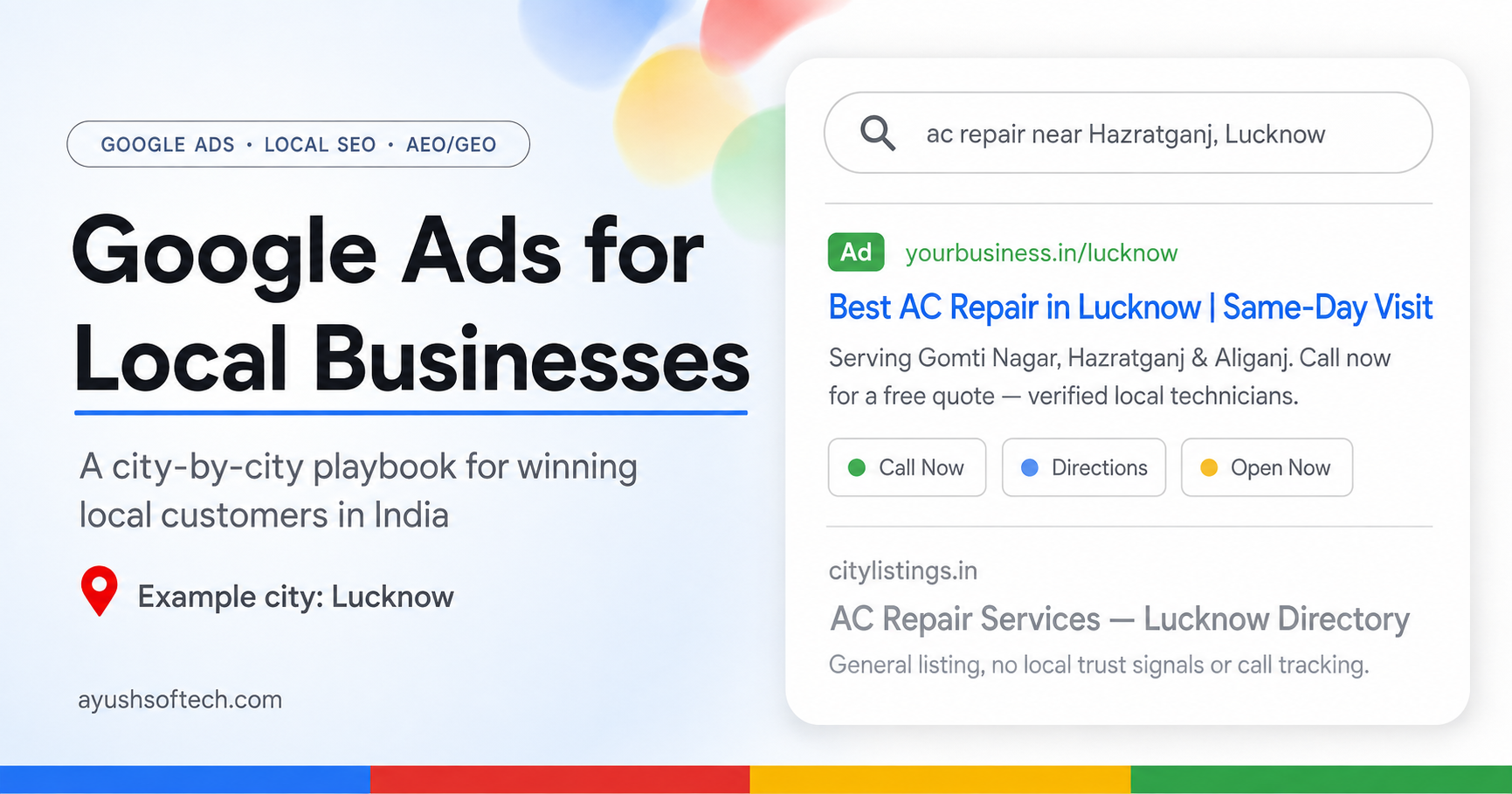
Quick answer: Google Ads strategies for local businesses in India all point to the same starting move: don’t run one generic campaign and hope. Geo-target your exact city using Google’s “Presence” location setting (not just interest), pair local-intent keywords with a disciplined negative keyword list, structure campaigns by service rather than lumping everything together, write mobile-first ad copy that names the city and neighbourhood, link a fully optimized Google Business Profile for trust, track phone calls as a real conversion, and choose a bidding strategy that matches how much conversion data you actually have. None of this is exotic. It’s disciplined, city-specific execution — and it’s exactly where most local advertisers in India leave money on the table.
If you run a clinic in Lucknow, a furniture showroom in Jaipur, or a home-services business in Coimbatore, this guide walks through the Google Ads strategies for local businesses that actually move the needle, in the order you should set them up. If you’d rather have this set up for you end-to-end, this is exactly the kind of account structure our Google Ads management service builds from day one.
Why Google Ads Strategies for Local Businesses Must Be City-Specific
India isn’t one market — it’s a federation of very different local markets, each with its own language mix, price sensitivity, and search behaviour. A default, out-of-the-box Google Ads campaign targeting “India” will happily spend your budget showing ads to people 900 kilometres away who were never going to walk into your shop. For a local business, that isn’t reach — it’s waste.
Take a mid-size city like Lucknow as a working example throughout this guide. A dentist in Gomti Nagar doesn’t need impressions in Mumbai; they need the person searching “root canal treatment near Hazratganj” at 9 pm on their phone. Every strategy below is built around that kind of precision — it’s the difference between Google Ads strategies for local businesses that work and a national playbook copy-pasted onto a local budget.
1. Set Up Precise Geo-Targeting Using “Presence,” Not “Interest”
This is the single most common mistake local advertisers make in Google Ads, and it’s an easy fix.
Inside campaign settings, Google Ads offers two location targeting modes:
- “Presence: People in or regularly in your targeted locations” — shows your ad only to people who are physically in or near the city you’ve selected.
- “Presence or interest” (the older default) — also shows your ad to people anywhere in the world who are simply searching about your city, even if they’re nowhere near it.
For a local business, “Presence or interest” quietly burns budget on people researching a city they don’t live in — a common cause of clicks that never turn into customers. Switch to Presence only in the Locations settings, then:
- Target the specific city (e.g., Lucknow) rather than the whole state.
- For businesses that serve a smaller radius, use a radius target (5–15 km) around the shop or clinic instead of the whole city.
- If you have well-defined service pockets — say Gomti Nagar, Hazratganj, and Aliganj — you can layer locality-level radius targets around each one for tighter control.
- Explicitly exclude locations you don’t serve if your business name or category could confuse Google’s system into showing you elsewhere.
Getting this one setting right is the foundation of effective Google Ads strategies for local businesses — for the full mechanics, Google’s own guide to location targeting is worth a read before you flip the switch.
2. Build Keyword Lists Around Local Intent — and Use Negative Keywords Aggressively
Local-intent keywords are the ones that pair a service with a place or a “near me” signal: “AC repair Lucknow,” “best salon near Hazratganj,” “packers and movers in Gomti Nagar.” These convert at a fundamentally different rate than generic head terms like “AC repair,” which pull in traffic from every city in the country and every intent from research to job-hunting.
Just as important is what you exclude. A tight negative keyword list is what keeps a local budget from leaking into irrelevant clicks:
- Job-seeker terms: “jobs,” “vacancy,” “salary,” “internship”
- DIY and free-seeker terms: “free,” “how to fix,” “DIY,” “course,” “training”
- Names of cities and areas you don’t serve
- Competitor brand terms, unless you’re deliberately running a comparison campaign
Review your Search Terms report weekly for the first month of any new campaign — this is where you’ll find the negative keywords you didn’t think to add up front, and it’s the fastest way to stop paying for the wrong clicks. This overlaps heavily with organic local SEO keyword research too, so it’s worth building the two lists together rather than in isolation.
Good Google Ads strategies for local businesses treat this list as a living document, not a one-time setup — Google’s own guide to negative keywords is a useful reference as you expand it.
3. Structure Your Campaign Around Services, Not One Big Bucket
A single campaign covering everything a business does makes it almost impossible to control budget, bidding, or ad copy per offering. The stronger campaign structure separates by service line (and, for multi-branch businesses, by location):
- A dental clinic might run separate ad groups — or campaigns — for “dental implants,” “root canal treatment,” and “teeth whitening,” each with its own keywords, ad copy, and landing page.
- A business with two Lucknow outlets and one in Kanpur should generally run location-specific campaigns so each branch’s budget, bids, and ad copy can reflect that branch’s phone number, address, and local performance — rather than averaging results across cities that behave differently.
This structure also makes budgeting far more precise: you can see exactly which service or branch is producing calls and bookings, and shift spend accordingly, instead of guessing from a blended number. This kind of structure is a hallmark of mature Google Ads strategies for local businesses with more than one branch or service line.
4. Write Hyper-Local, Mobile-First Ad Copy
Ad copy that could run in any city in India is ad copy that resonates with no one in particular. The local businesses that stand out do the opposite:
- Name the city or locality directly in headlines: “Trusted Dentist in Gomti Nagar, Lucknow” beats “Best Dental Clinic” every time on relevance and click-through.
- Use local trust signals: years serving the area, number of local customers, same-day service availability.
- Include the local phone number and area code — it’s a small detail that quietly signals “we’re actually here.”
- Lean on call extensions, location extensions, and sitelinks pointing to directions, services, and a quick-contact option like WhatsApp.
And write for mobile first. The overwhelming majority of local searches in India — “near me,” service, and city-name queries especially — happen on a phone, often on the move. That means short, scannable headlines, a click-to-call button that actually works, and a landing page that loads fast on a mid-range Android device on a patchy connection, not just on office Wi-Fi.
5. Link and Actively Maintain Your Google Business Profile
Connecting your Google Business Profile to your Google Ads account does more than tidy up your dashboard — it lets your ads pull in location extensions: your address, a map pin, business hours, and directions, right inside the ad itself. That combination of a paid ad backed by a real, active local listing is one of the strongest trust signals you can show a first-time searcher.
Keep the profile itself in good shape alongside the ads — see our Google Business Profile optimization guide for the full checklist, but at minimum:
- Photos that are current and actually of your location, not stock images
- Business hours kept accurate, especially around holidays
- Reviews responded to — both good and bad — since responsiveness itself is a trust signal to new customers landing from an ad
Reviews matter enough that Google publishes its own tips for getting more reviews — worth pairing with any of the Google Ads strategies for local businesses covered here, since ad clicks convert better when the listing behind them looks active.
6. Treat Phone Calls as a Primary Conversion, Not an Afterthought
For a huge share of local service categories in India — clinics, repair services, salons, legal and financial consultants — the customer’s real “conversion” moment is a phone call, not a form submission. If your Google Ads account is only tracking form fills or purchases, you’re blind to a large part of what’s actually working.
Set up call tracking: Google’s own call extensions and call-only ads can report call conversions directly, and third-party call tracking numbers (swapped dynamically on your site) let you attribute calls back to the exact campaign, ad group, and even keyword that generated them. This matters for two reasons — it tells you honestly which campaigns are working, and it feeds Google’s automated bidding systems the real conversion signal they need to optimize correctly. Without accurate call data, Smart Bidding is optimizing against an incomplete picture.
7. Choose a Bidding Strategy That Matches Your Data, Not Your Ambition
A common misstep is jumping straight to an automated bidding strategy like Target CPA or Target ROAS before the account has enough conversion history to make it work.
A more reliable progression for a local business:
- Start with Manual CPC or Maximize Clicks while the campaign is new, so you can build a real base of clicks and conversion data.
- Move to Maximize Conversions once you have a reasonable, steady flow of tracked conversions (calls and form fills combined) — typically after several weeks of consistent data.
- Only consider Target CPA or Target ROAS once you have enough conversion volume for the algorithm to learn from reliably — jumping there too early, on thin data, tends to produce erratic, expensive results rather than efficiency.
This progression is one of the most overlooked Google Ads strategies for local businesses — most accounts fail not because the algorithm is bad, but because they hand it too little data too soon.
8. Budget Realistically for Your City's Market
Cost-per-click in Google Ads varies enormously by industry and by city. As a general pattern, competitive service categories in metro markets like Mumbai, Delhi NCR, and Bengaluru tend to carry noticeably higher CPCs than the same categories in Tier-2 cities like Lucknow, Jaipur, or Coimbatore — which is actually good news for local businesses outside the biggest metros, since local competition for the same keywords is often lighter.
Rather than fixating on an ideal daily number, treat your first few weeks as a controlled test: set a modest, sustainable daily budget, let it run long enough to gather a genuine sample of clicks and conversions, and use that real data — not guesswork — to decide whether to raise it. Ad scheduling (dayparting) is worth layering in early too, so budget isn’t spent showing ads at 3 am when nobody’s calling.
9. Build a Dedicated, Localized Landing Page — Not Just Your Homepage
Sending a hyper-local ad to a generic homepage breaks the promise you just made in the ad. A properly built localized landing page should mirror the ad’s message directly: same city or locality name, same service, and a single clear next step — a prominent call button, a WhatsApp chat option, or a short enquiry form, not all three competing for attention.
Strong local landing pages also carry the same trust signals as the ad itself: an embedded Google reviews widget, real photos of the actual location or team, and a mobile layout that loads in a couple of seconds, not ten.
10. Know Where Else Local Intent Lives
Google Search should be the anchor for qualified, high-intent local leads — but it’s worth knowing that a share of local buying and service intent in India also flows through classifieds and marketplace platforms like OLX, particularly for categories like used goods, rentals, and certain local services. That’s not a reason to shift ad budget away from Google Ads, which remains the stronger channel for capturing active, high-intent search demand — but a local business doing a full visibility audit shouldn’t assume Google Search is the only place potential customers are looking.
Test, Track, and Optimize With Real Local Data
Everything above is a starting structure, not a “set and forget” system. The businesses that keep improving their results treat the account as a living thing:
- Review the Search Terms report weekly and keep tightening the negative keyword list.
- Track performance by locality if you’re running radius or multi-area targeting — some neighbourhoods will consistently outperform others.
- A/B test ad copy variations, particularly different local trust signals and calls to action.
- Watch performance by device and time of day, and adjust bids or scheduling to match when your specific city’s customers are actually searching.
Treat this ongoing review process as part of your core Google Ads strategies for local businesses, not a one-time launch checklist.
A Simple Framework to Start
Bring the Google Ads strategies for local businesses covered above together in one sequence:
| Step | What to do |
|---|---|
| 1 | Set location targeting to “Presence,” scoped to your exact city or a radius around it |
| 2 | Build local-intent keywords + a strong negative keyword list |
| 3 | Structure campaigns by service (and by branch, if multi-location) |
| 4 | Write mobile-first ad copy naming the city/locality |
| 5 | Link and actively maintain your Google Business Profile |
| 6 | Set up call tracking as a tracked conversion |
| 7 | Start with Manual CPC/Maximize Clicks, graduate to automated bidding once you have data |
| 8 | Set a realistic test budget for your city’s competitive level |
| 9 | Build a matching, localized landing page for each campaign |
| 10 | Review search terms and performance weekly, and keep refining |
Frequently Asked Questions
Should I target my whole city or just specific localities?
It depends on how far customers realistically travel for your business. A destination business (a specialty clinic, a large showroom) can usually target the whole city; a walk-in or delivery-radius business (a salon, a local repair service, a restaurant) usually performs better with a tighter radius target around its actual location.
What's a good starting daily budget for a local business in a city like Lucknow?
There’s no universal number — it depends heavily on your industry’s competitiveness and typical cost-per-click in that category. The more useful approach is to start with a modest, sustainable budget, run it long enough to gather a real sample of data, and let actual cost-per-conversion numbers guide any increase, rather than picking a figure in advance.
Are phone calls really more important to track than form fills?
For many local service categories in India, yes — calls are often the primary way customers actually convert, especially on mobile. If call conversions aren’t being tracked, a big part of what’s working (or not) in the account stays invisible.
Do I need a separate landing page for every service I advertise?
Ideally, yes, or at least a dedicated section per service. A landing page that matches the exact promise made in the ad — same service, same city — converts meaningfully better than sending everyone to a general homepage.
How is this different from traditional SEO advice for local businesses?
The underlying local-relevance principles overlap with SEO — city-specific content, Google Business Profile optimization, mobile performance — but Google Ads adds paid-specific levers SEO doesn’t touch directly: location targeting settings, negative keywords, bidding strategy, and call tracking as a conversion event. The two work best run together, not as alternatives to each other.
What are the most effective Google Ads strategies for local businesses in India?
The Google Ads strategies for local businesses that consistently perform best combine precise city-level location targeting, a disciplined negative keyword list, service-based campaign structure, mobile-first local ad copy, an actively maintained Google Business Profile, and call tracking as a real conversion — used together rather than in isolation.
This guide was put together by the content and digital strategy team at Ayush Software Technologies, who build Google Ads strategies for local businesses across India — from setup and call tracking to city-specific campaign structure that actually holds up in a market like Lucknow. If you’re setting up or restructuring a local Google Ads account, it’s the kind of groundwork worth getting right from the first campaign rather than fixing six months in. Get in touch if you’d like us to set it up for you.



Leave a comment