- August 20, 2026
- 0 Comments
- By admin
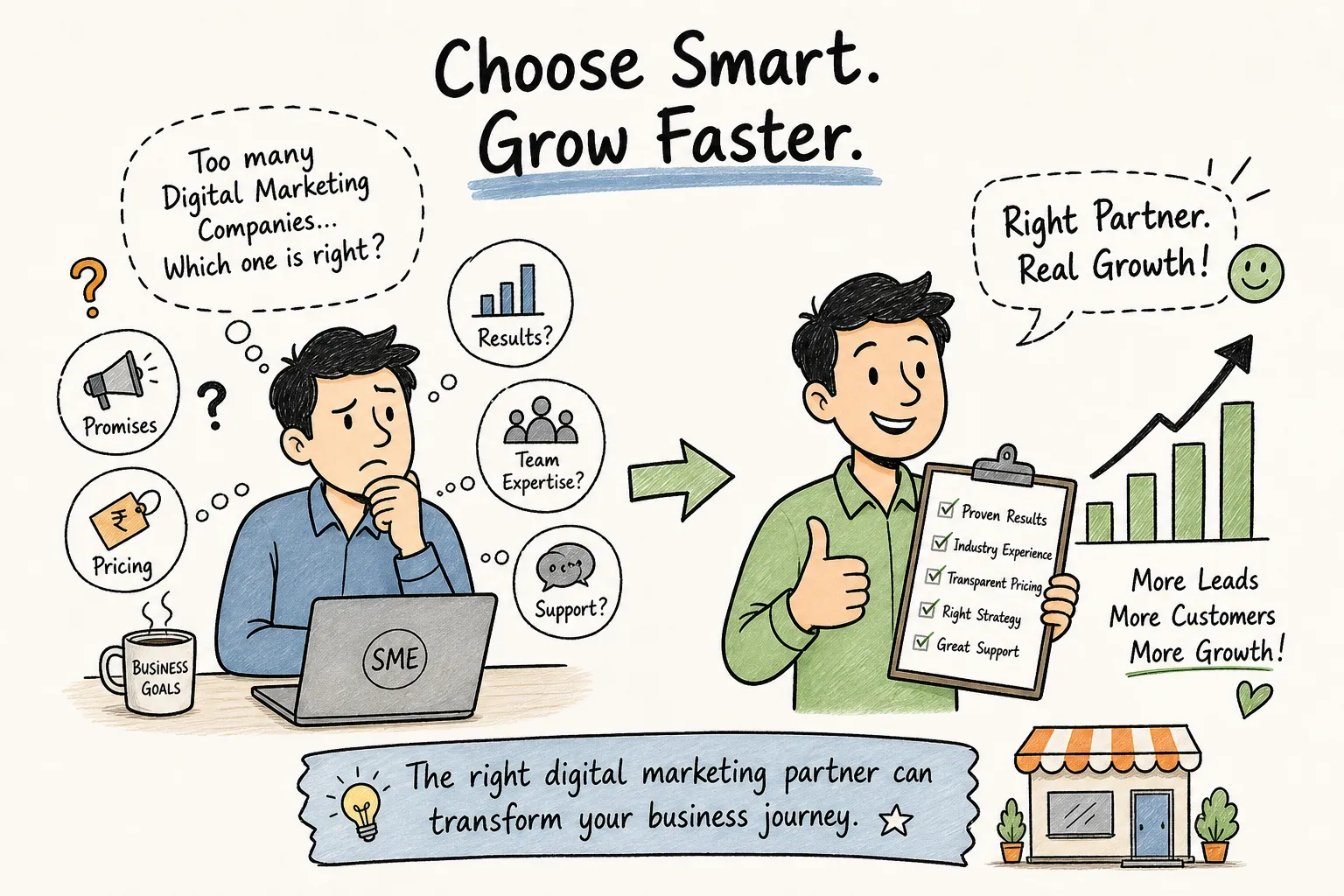
Search “digital marketing agency India” and you’ll get thousands of results. Every listing claims to be “result-driven,” “ROI-focused,” and “your growth partner.” The problem isn’t finding options, it’s knowing which agencies actually deliver for a business your size, budget, and market. Most SMB owners spend weeks collecting proposals and still end up making uninformed decisions.
This article gives you a practical framework to cut that process down significantly. You’ll understand what services to expect, what you should realistically pay in 2026, how to verify an agency’s track record with real data, and which contract terms protect your budget. If your business operates in Lucknow or Uttar Pradesh, there’s also a section on why local expertise matters more than most business owners realise.
What Indian digital marketing companies actually offer
Most credible Indian digital marketing companies cover five core services: SEO, paid advertising (primarily Google Ads and Meta), social media management, website development, and branding. These five form the baseline. If an agency is missing two or more without a clear, documented specialisation reason, for instance, an explicit niche focus or a disclosed third-party partnership, that warrants a direct conversation before you proceed.
The choice between a full-service agency and a single-channel specialist depends on where you are as a business. Single-channel specialists work well when you already have an internal marketing team and need one expert to manage, say, Google Ads alone. For most SMBs without a dedicated marketing department, a full-service agency is more practical. You get a single point of contact, a coordinated strategy across channels, and no gaps between teams deflecting responsibility when results dip.
Your growth stage should also shape what you prioritise. A startup validating its offer needs fast lead generation: Google Ads and a well-built landing page. An established business wanting sustainable growth needs SEO and content. An e-commerce brand scaling revenue needs paid social and conversion rate optimisation. Identifying your priority channel first makes shortlisting agencies dramatically faster, and it helps you test whether an agency’s recommendation actually fits your situation or is simply their standard sales pitch.
How agency pricing is structured in India
Boutique agencies typically charge between ₹35,000 and ₹1.5 lakh per month. At this range, you’re usually working with a small team of two to four people, sometimes a solo consultant with contractors. Execution is hands-on, but capacity is limited. These arrangements work well for businesses with a single clear objective and a modest monthly ad budget. They are not suited to businesses that need multi-channel management and strategic oversight.
Mid-market agencies run between ₹1.5 lakh and ₹10 lakh per month depending on scope. This tier gives you dedicated account managers, structured reporting, and multi-channel capability. Most small and medium businesses with serious growth targets will find the right balance of quality and cost somewhere in the ₹1.5, ₹4 lakh per month range. Many credible full-service Indian digital marketing companies operate at this level, making it the most competitive and option-rich tier for SMBs.
Premium and network-affiliated agencies start around ₹8 lakh and can exceed ₹25 lakh per month. They serve large brands with complex requirements across multiple markets. For most Indian SMBs, this tier adds overhead, hierarchy, and minimum spends that don’t suit a lean business. Knowing these tiers upfront helps you filter immediately: don’t waste time speaking to agencies whose minimum engagement is five times your budget.
The checklist every SMB should use before signing
Ask for case studies, not testimonials. A case study worth reading states the client’s starting point, the strategy used, and the specific outcome: traffic growth percentage, leads generated, cost per lead, or revenue attributed. To give you a sense of what strong performance looks like: agencies with solid track records in competitive Indian niches have published outcomes such as 103% average traffic growth, 5.7x lead increases, and 340% organic traffic growth for e-commerce clients within six months, though these are agency-reported figures from individual case studies, not guaranteed industry norms. Use them as a benchmark for the quality of proof you should expect, not as a promise any agency can make. If a prospective agency cannot show you verified, specific outcomes for past clients, be cautious.
The questions you ask during evaluation reveal more than any brochure. Ask specifically: who will handle my account day-to-day, the senior who pitched to me or a junior executive? How often will I receive performance reports, and in what format? What happens if results plateau after three months? How do you handle ad spend that isn’t converting? A confident, process-driven team answers these without hesitation. Vague answers here are a reliable preview of vague communication once you’re signed on.
Watch for red flags that should end any conversation immediately:
- Guaranteed first-page rankings within 30 days
- Rigid packages quoted before understanding your goals
- Refusal to share campaign-level access to your Google Ads or Analytics account
- Contracts that make it difficult or costly to exit
On that last point: a standard notice period is 30 days. If an agency is asking for 90 days’ notice or long lock-in clauses with steep exit penalties, that’s a sign they know clients leave and are protecting themselves, not you.
What real results look like: setting your expectations
For SEO in many local and niche campaigns, expect to see meaningful traffic movement within three to six months. Note that highly competitive verticals, finance, real estate, healthcare, often take considerably longer, sometimes nine to twelve months, before organic gains become substantial. Verified agency case studies report organic traffic increases in the range of 120% to 340% for e-commerce and services businesses, though timelines vary by sector and starting position. For lead generation, Indian agencies managing Google Ads for local businesses report cost-per-lead benchmarks of ₹300, ₹1,500 for most non-enterprise campaigns, with experienced teams cutting CPL by 25, 30% within the first quarter through proper audience targeting and negative keyword management, figures drawn from agency-reported outcomes rather than independently audited data.
Set these expectations in writing. Include agreed KPIs in your contract; this single step does more for a productive agency relationship than anything else. If your agency is six months in and organic sessions are flat, that’s a conversation to have, backed by data you agreed on at the start. If your cost-per-lead has increased since the agency took over your Google Ads account, that’s a problem to solve immediately, not after the next billing cycle.
One point that’s often underestimated: no amount of SEO or paid advertising performs well on a slow, poorly structured website. A responsive, fast-loading site is not optional; it’s the foundation your marketing budget sits on. When evaluating agencies, check whether website development is an in-house capability or subcontracted. In-house capability is often preferable for integration, speed, and accountability when something breaks, subcontracting isn’t automatically a disqualifier, but you should understand the arrangement before signing.
Why location matters for Lucknow and UP businesses
Lucknow and the broader Uttar Pradesh market have distinct consumer behaviour patterns, seasonal demand cycles, and competitive dynamics that a Delhi or Mumbai agency is often not well-positioned to understand from a distance. Regional search intent, local language nuance in content, and the right local citation strategy for Google My Business listings are all areas where a locally-rooted agency tends to have a practical edge. That difference shows up in the details: which keywords actually drive conversions locally, which ad copy resonates with a UP audience, and what pricing benchmarks are realistic for this market rather than calibrated to metro clients.
Pricing is also meaningfully different. Lucknow-based agencies typically run 30, 40% lower than Delhi NCR agencies for comparable monthly scope. Local SEO and GMB management, for example, is commonly quoted at ₹7,000, ₹15,000 per month in Lucknow versus ₹12,000, ₹25,000 per month in Delhi NCR. For SMBs operating on a considered budget, that difference compounds significantly across a 12-month engagement.
Ayush Softech, based in Lucknow, is a full-service digital marketing agency covering SEO, Google Ads management, website development, social media marketing, and branding. For a UP-based startup or established SMB, the team’s familiarity with local competitive benchmarks, regional search patterns, and Lucknow-market cost structures is a practical advantage that a metro agency managing accounts from another city finds difficult to replicate. In one client engagement, Ayush Softech combined SEO restructuring and Google Ads campaign management with a new responsive website, resulting in improved organic visibility and a measurable reduction in cost-per-lead within the first six months. The website rebuild was the platform that made both channels more effective, exactly the integrated thinking that becomes harder to execute when your agency is managing your account from another city.
How to narrow your shortlist to one agency
The final decision comes down to three filters applied in sequence. First, filter by budget tier: only speak to agencies that routinely work with businesses at your monthly spend level. An agency whose smallest retainer is ₹5 lakh per month will not give a ₹1.5 lakh client meaningful attention. Second, filter by proof: shortlist only those with verifiable case studies in your specific channel, whether that’s SEO, Google Ads, or social media. Third, filter by communication: speak to at least two people from each agency’s team during evaluation. The quality of that conversation predicts the quality of the relationship once you’re on retainer.
When you reach out to request a proposal, give the agency a clear brief. Include your current business size or monthly revenue context, your top one or two growth objectives, your approximate budget range, and your timeline. The better your brief, the more specific and useful the proposal you receive. An agency that responds to a vague enquiry with an equally vague proposal is showing you exactly how they’ll handle your account once you sign.
Making your final decision with confidence
Choosing from the hundreds of Indian digital marketing companies operating across the country doesn’t have to be guesswork. The practical answer is a clear sequence: understand what services you actually need, match them to the right budget tier, verify results with real data rather than polished testimonials, and evaluate through direct conversation with the people who will actually work on your account.
For businesses in Lucknow and Uttar Pradesh, working with a local full-service agency removes the friction of market misalignment, metro-benchmarked pricing, and the communication gaps that come with managing a distant team. The right agency understands your market before the first meeting, not six months into the retainer.
Ayush Softech offers a customised proposal process built for exactly this: you describe your goals and current situation, and the team returns a plan scoped to your budget, your market, and your realistic six-month targets. Visit the Ayush Softech website to request your proposal and get a clear picture of what’s achievable for your business.



Leave a comment